— A NEW APPROACH HEALTH PROGRAM
Psychonutrition Certification Level 1
The clinical framework your training never gave you.
Built exclusively for Registered Dietitians ready to work with the psychological dimensions of eating, within scope of practice
37.5 CPEUs | 8 Modules | Scope-safe documentation at every level
Waitlist members lock in founding pricing.
— THE CHALLENGE
Your training didn't prepare you for the complexity your clients bring.
-
The client who can't eat breakfast because her nervous system doesn't feel safe
-
The nurse who binges after every 12-hour shift: dysregulation, not hunger
-
The mom who nods at your meal plan, then ghosts you for three weeks
You can see the nervous system dysregulation, the trauma history surfacing as GI dysfunction, the burnout converting into disordered eating.
You know something deeper is operating. Thiscertification teaches you how to name it, document it, and work with it inside your scope.
Emahlea Wilcher, MPH, MS, RD, LD, CPsyN
Founder & CEO, New Approach Health
Emahlea runs a trauma-informed nutrition therapy practice with a team of 11 dietitians working with eating disorders, gut health, nervous system dysregulation, and the cases where a client's eating problem is really a stress problem, an attachment problem, or a meaning problem. The Psychonutrition House came out of that clinical work: a structured, scope-safe way to hold nervous system patterns, disordered eating, body image, attachment, and meaning inside a single nutrition care model.
MPH in Nutritional Sciences and MS in Epidemiology from the University of Washington School of Public Health. Published researcher (SEARCH for Diabetes in Youth Study). UW Coordinated Dietetics Program.
— YOUR INSTRUCTOR


The CDR states that each RDN's scope of practice has "flexible boundaries" defined by education, training, credentialing, experience, and demonstrated competence. ANZAED practice standards require eating disorder dietitians to develop competencies in CBT-informed skills, DBT-informed skills, MI, trauma-informed care, and therapeutic alliance. This certification provides the training and documentation structure for that work.
— SCOPE
Scope grows with what you can train, apply, and document.
The first level of a three-part pathway to the Certified Psychonutritionist (CPsyN) credential. Built exclusively for Registered Dietitians.
Available as 3 standalone Parts or 1 complete Level 1 program.
37.5 CPEUs | 27+ Clinical Tools | 8 Modules Across 3 Parts
Level 1: Foundations of Psychonutrition
Total pathway: 100-115 CPEUs. Only RDs who complete all three levels, submit a full portfolio, and pass recorded session competency review earn the CPsyN credential.
CPsyN is a proprietary certification issued by New Approach Health demonstrating advanced training in trauma-informed, nervous-system-focused nutrition care.
— CERTIFICATION PATHWAY
The CPsyN Credential
| Level | Focus | CPEUs | Timeline |
|---|---|---|---|
| Level 1 | Foundations of Psychonutrition | 37.5 | Now enrolling |
| Level 2 | Advanced Clinical Applications | 30-35 | Fall 2026 |
| Level 3 | Practicum + Certification | 30-40 | 2027 |
— THE PSYCHONUTRITION HOUSE
The House
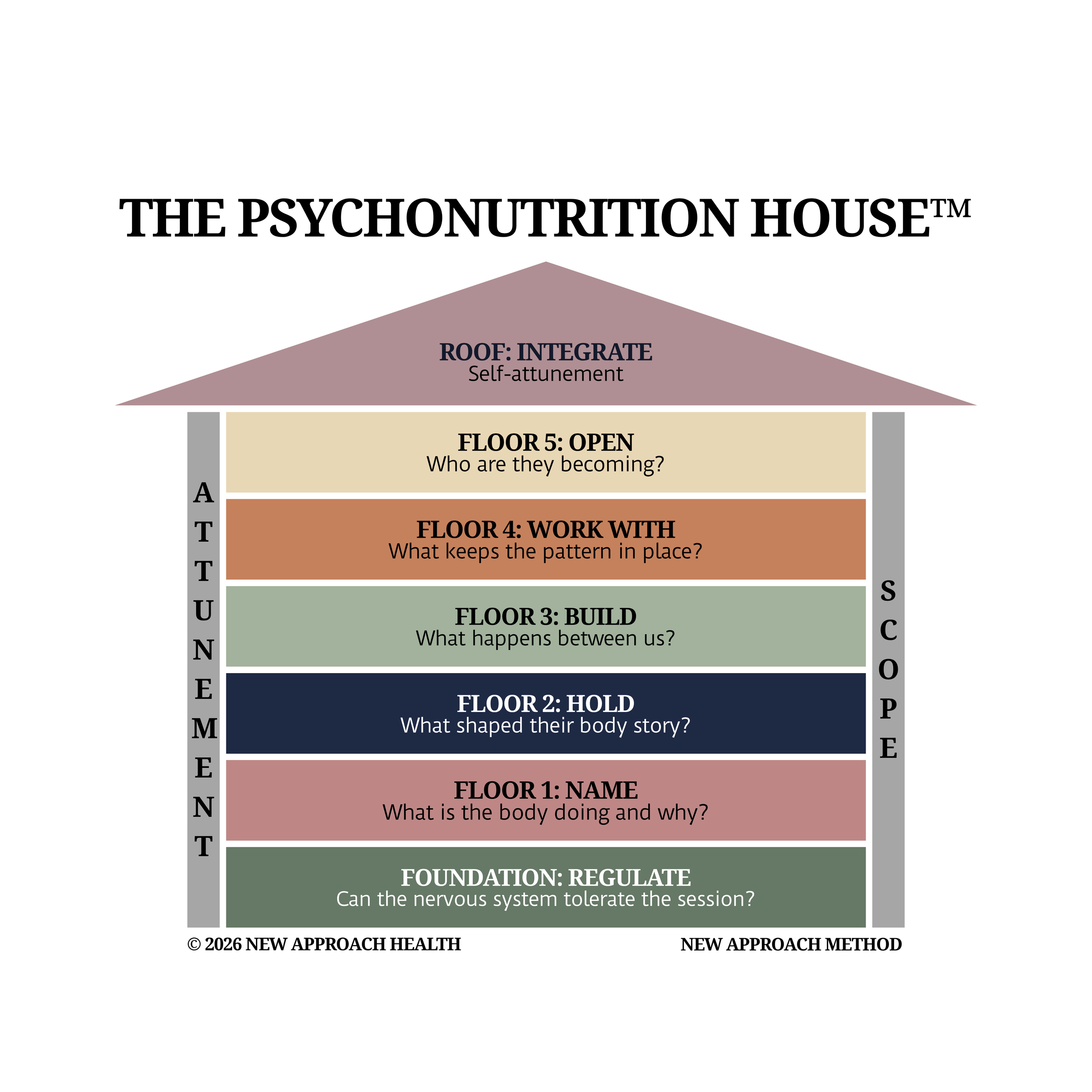
A clinical decision tool for the whole person.
Each level answers a specific clinical question. Each has a verb that tells you what to do there
Foundation: Regulate — nervous system regulation
Floor 1: Name — pattern identification and articulation
Floor 2: Hold — body image and cultural context
Floor 3: Build — attachment and relational attunement
Floor 4: Work With — resistance and motivational complexity
Floor 5: Open — meaning, purpose, and daily rhythm
Roof: Integrate — whole-house clinical assessment
Two load-bearing walls run through every level. Attunement keeps you connected to the client's experience. Scope keeps every intervention defensible. You work from the Foundation up. If the nervous system is dysregulated, nothing above it holds.
— CURRICULUM
What You’ll Learn
8 modules. 37.5 CPEUs. Available as 3 standalone Parts or 1 complete Level 1 program.
Scope & Regulation

Introduction | The Psychonutritionist
4.5 CPEUCourse framework, the Psychonutrition House™, three channels of attunement, CDR scope boundaries, ethical guidelines, referral protocols, and the Clinician Self-Inventory.

Foundation | Regulate
9 CPEUAutonomic regulation, interoception, gut-brain axis, somatic-informed tools, window of tolerance, body-based cue monitoring, and non-verbal safety signaling. The science and the tools for reading the client's nervous system.
Patterns & Context

Floor 1 | Name
5 CPEUState-based eating patterns, the function reframe, chronic stress and burnout physiology, validated screening tools, and clinical documentation. Identify what the body is doing and articulate why.

Floor 2 | Hold
4 CPEUDiet culture as structural context, body image, the appearance-to-eating pipeline, cultural humility, functional body frameworks, and values-based body approaches.
Relationship, Resistance & Integration

Floor 3 | Build
4 CPEUAttachment theory applied to nutrition encounters, the secure-base RDN stance, co-regulation as clinical process, and countertransference awareness.

Floor 4 | Work With
4 CPEUMotivational interviewing, self-determination theory, the eating disorder as attachment object, and the difference between motivational ambivalence and identity-preservation resistance.

Floor 5 | Open
4 CPEUMeaning-based food practices, radical acceptance applied to food and body, post-traumatic growth, habitual eating patterns, and chrono-nutrition.
Roof | Integrate
3 CPEUWhole-house clinical assessment, the arc from co-regulation to self-regulation, comprehensive case integration, and the clinical capstone.
— TOOLS
27 Clinical Tools
Assessment
Hunger, Fullness, Satiety & Comfort Scale (HFSC)
Nutrition outcome variables
Pre-Meal Autonomic Check-In (PACI)
Session readiness
State-Behavior Mapping Tool (SBMT)
Maps autonomic state to eating behavior in real time
Burnout-Nutrition Impact Assessment (BNIA)
Screens for nutritional consequences of chronic stress
Window of Tolerance Integration Scale (WIS)
Nutrition challenge readiness
Attachment-Informed Nutrition Engagement Assessment (AINEA)
Relational pattern identification
Psychonutrition House™ Floor Assessment Protocol (PHFAP)
Whole-house clinical snapshot
Session Tools
Post-Meal Interoceptive Assessment (PMIA)
Post-meal body signal tracking
Interoceptive Recovery Tracking (IRT)
Longitudinal interoceptive monitoring
Body-Cue Pattern Record (BCPR)
Links sensation to eating behavior
Meaning-Purpose-Nutrition Alignment Tool (MPNAT)
Connects values to nutritional goals
SDT-Aligned Session Design Template
Session planning grounded in self-determination theory
Prioritization Matrix
When multiple floors are active, which one first
Clinician Development
Secure-Base Self-Assessment
Countertransference Awareness Log
Clinician Self-Inventory
Documentation & Referral
Scope-Safe Documentation Templates
NCP charting language for every floor of the House
Contain-Refer-Document Protocol
Trauma disclosure, suicidality, or active ED
Built for the nutrition encounter. Scope-safe. Clinically documented.
Plus worksheets, handouts, and clinical vignette materials in every module.
— WHO ITS FOR
Is This For You?
This is an RD-only certification for clinicians ready to examine their own patterns alongside their clients'.
— THE EVIDENCE
Why This Framework. Why Now.
The complexity is here. A 2024 meta-analysis of over 10,000 dietitians found a burnout prevalence of 40.43%, up from 26.3% in 2018. Your clients carry this same load.
The scope supports it. The CDR's Revised 2024 Standards define RDN scope as having "flexible boundaries" determined by education, training, and demonstrated competence. This certification provides the training and documentation structure the CDR framework is built to recognize.
The precedent exists. ANZAED practice standards require eating disorder dietitians to develop competencies in CBT-informed skills, DBT-informed skills, MI, trauma-informed care, and therapeutic alliance. SE-informed and depth-informed skills apply the same principle.
The research asks for it. A 2023 NIH publication calls for "the comprehensive integration of psychological principles into health care." Polyvagal theory is being applied directly to gut-brain interaction disorders. The evidence base is converging: eating behavior is a nervous system event.
— TRANSFORMATION
Before and After Level 1
What Beta Testers Said
-
"This is the first thing that actually put MI, trauma-informed work, and somatic skills together inside a framework I can use Monday morning with a real client."
—RD in private practice
-
"The scope language section alone was worth my time. I've been doing this work for 3 years and couldn't explain to a supervisor why it's within my scope. Now I have the exact documentation phrasing."
—RD in outpatient clinical setting
-
"The attachment module changed how I think about adherence. I'd been taking 'noncompliance' personally for years. There's a pattern underneath it. My documentation got cleaner because I finally had language for what I was observing."
—RD specializing in eating disorders
-
"This felt like being trained by someone who's actually done the clinical work and can tell you exactly where the gray zones are."
—RD in hospital-based practice
— INVESTMENT
Founding Cohort
15 seats. These RDs get direct access, biweekly Q&A, and their feedback shapes the final version. The price reflects their role in building the program.
Level 1 will be $997 after the founding cohort. These 15 seats are $797.
Complete Level 1 (Recommended)
$797 | 37.5 CPEUs
- All 8 modules across 3 Parts
- 27+ proprietary clinical tools
- Lifetime access to materials and updates
- Biweekly live Q&A with Emahlea
- Alumni pricing for Level 2 and Level 3
- Level 1 certificate upon completion
7-day money-back guarantee. Complete Module 0; if it's not for you, full refund.
Founding cohort pricing ends May 18, 2026.
Join the WaitlistOr start with a single Part:
-
37.5 under the CDR's self-reported professional development policy. Formal CDR approval is in process; founding cohort members receive official CPEUs retroactively once approved
-
37.5 hours of didactic content plus 5-10 hours for reflection and case applications. Self-paced with biweekly live Q&A.
-
No. Module 0 starts with fundamentals. If you already use MI, you'll recognize the principle immediately.
-
Yes. All tools are designed for scope-safe use within the CDR's flexible scope framework. Every module includes Green/Yellow/Red zone checks and documentation language.
-
7-day money-back guarantee. Complete Module 0; if it's not for you, full refund.
-
Yes. Part I is open to any credentialed RDN. Parts II and III require the preceding Part(s).
-
A certificate of completion with CPEUs for each Part. The Level 1 certificate requires all three Parts and all four deliverables.
-
Level 2 opens Fall 2026. Level 3 opens 2027. Level 1 graduates get early access and alumni pricing.
— FAQ
Common Questions